A scheduled move-out clearance handles full-property cleanouts when a tenant vacates or a seller finishes packing, targeting the exact gap between moving day and key handover. A full-service clearance crew loads the…
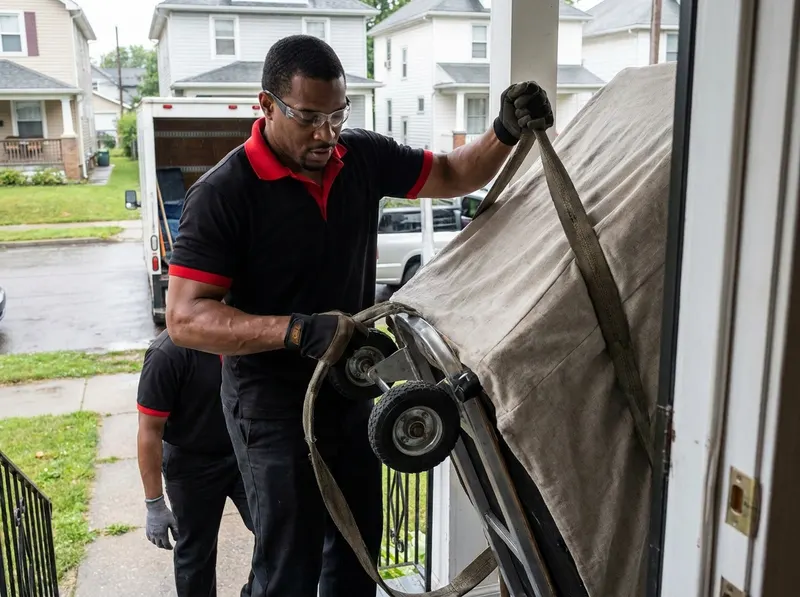
A scheduled move-out clearance handles full-property cleanouts when a tenant vacates or a seller finishes packing, targeting the exact gap between moving day and key handover. A full-service clearance crew loads the debris directly into the haul vehicle, which eliminates parking a roll-off container on high-density residential streets. In tight street grids like Tremont, Ohio City, and Detroit-Shoreway, parking an open dumpster requires a City of Cleveland street obstruction permit if the driveway cannot accommodate an eight-foot-wide container. Choosing a live-load clearance avoids permit fees and prevents debris from sitting out on narrow neighborhood curbs. The trade-off is scheduling: roll-off dumpsters allow self-paced loading over seven days, whereas a scheduled clearance requires all items to be staged and ready for immediate loading during a single two-to-four-hour appointment window.
Loading crews navigate local property layouts including steep basement stairs in century-old Slavic Village duplexes and tight shared driveways in Lakewood-adjacent Kamm's Corners and Edgewater. Standard operations follow a clear sequence: 1. Confirm the inventory list, stage items near primary access doors, and verify off-street parking clearance for the haul truck. 2. Carry heavy bulky furniture, boxed items, and loose debris directly from basements, attics, or garages to the truck. 3. Perform a final sweep of the cleared floor areas to remove nails, drywall dust, and loose paper fragments.
Clearance volume is measured by truck fractions, where a quarter-truck covers roughly two pickup truck beds (around three to four cubic yards) and a full truck holds sixteen cubic yards. Property owners managing multi-family turnarounds in Clark-Fulton or University Circle student rentals should stage items by material type to streamline disposal sorting. Regulated materials such as wet paint cans, vehicle tires, lead-acid batteries, and freon-containing refrigerators cannot be mixed into standard residential trash loads under Ohio EPA and Cuyahoga County Solid Waste District transfer guidelines. Hazardous chemicals must go to designated county municipal roundups rather than general sorting stations.
Every job gets a firm, written price after a free on-site visit.
Tell us about your scheduled move-out clearance service job in Cleveland and we'll send a clear, written quote, usually the same day.
 Superior Dumpster Rental